 pebble
Learning to combine operations
How much of a memory does a model learn to use when it must combine a sequence of actions?
Memory can hold instructions as well as facts. If a model sees a sequence of operations, can it learn one operation that has the same combined effect? And how much memory does that require?
We study this using sequences of rearrangements. Mathematics gives us a compact matrix representation of their combined effect, so we can compare what training learns with a known target.
The experiment
A model reads a sequence of moves and produces a matrix representing the overall operation. Its training examples pair each sequence with the correct matrix, calculated from those moves. We test five families of operations, using targets that require between two and five independent directions.
The model has room to produce a larger matrix than it needs. We ask how many directions it actually uses, measured by rank, and what happens when we limit that number during training.
What we found
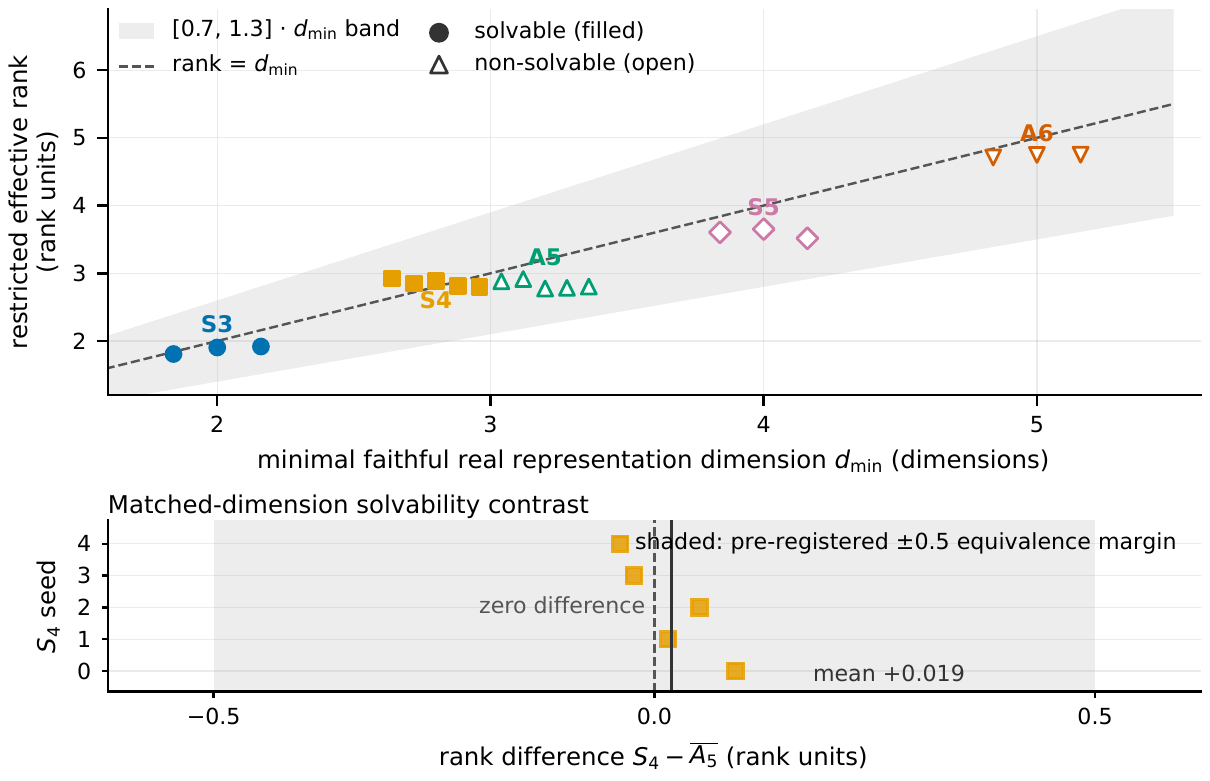
The learned rank closely followed the dimension required by the chosen target representation. Two different families with the same required dimension also learned similar ranks. Within these tasks, the representation’s size helped explain how much of the matrix training used.
Changing the available rank
When we capped rank below the target’s requirement, the model could not reproduce the target accurately enough to pass. That failure follows from the mathematics of the setup. The experimental question was whether training would succeed once it had enough rank. It met the study’s recovery criterion at that dimension in all five families.
The result links a known requirement to what a trained model uses. This is useful for designing memory tasks where capacity can be tested directly.
The target representation is supplied in training. The experiment therefore explains learning within this chosen representation; it does not show that every possible way of encoding the same task needs the same rank.
The paper
The Rank the Task Demands: A Causal Rank Law for Matrix Memories Trained on Group Composition
Samuel Larson. September 10, 2026.
Cite this paper
@misc{larson2026ranktaskdemandscausal,
      title={The Rank the Task Demands: A Causal Rank Law for Matrix Memories Trained on Group Composition},
      author={Samuel Larson},
      year={2026},
      eprint={2609.12259},
      archivePrefix={arXiv},
      primaryClass={cs.LG},
      url={https://arxiv.org/abs/2609.12259},
}
BibTeX from arXiv