 pebble
Checking whether the memory matters
Giving a model a structured memory is only useful if it learns to rely on it.
Some language models work through a problem using internal states instead of writing out each reasoning step. A matrix gives those states a structure we can inspect. The hope is that it could help a model keep track of several pieces of a problem at once. But adding that structure does not tell us whether the model uses it.
This study asks a simple question: if we remove much of the structure from the memory, do the model’s answers get worse?
The experiment
I tested Matrix-CODI, a model that passes its intermediate reasoning through a matrix. A matrix’s rank counts its independent directions. During evaluation, I kept fewer of those directions and measured the effect on problem-solving accuracy. I also changed how the model reads the matrix to check whether the result depended on that choice.
What happened
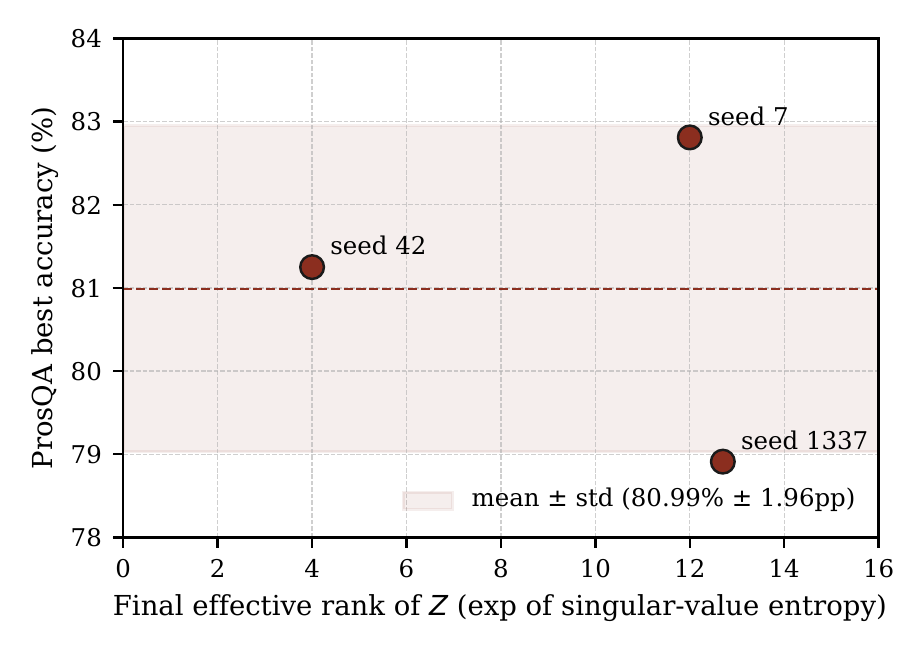
Removing most of the rank barely changed accuracy. That pattern persisted across the tested training settings and several ways of reading the matrix. Separate training runs also ended with different ranks, without a consistent relationship to accuracy.
What the controls changed
A model without the matrix produced a similarly flat response to the corresponding intervention. Replacing the tested hidden states with random noise also left accuracy much the same. That raised a more basic concern: the model might not need the positions where we were making the changes.
The result shows why a memory’s appearance is not enough to explain what a model is doing. Before interpreting its rank as a measure of reasoning, we need to establish that the model actually depends on that memory.
That motivated the next study: give the model a task with a known memory requirement, and make it answer using only what it stored.
The paper
The Gradient Does Not See Rank: Rank-Indifference in Matrix-CODI on ProsQA
Samuel Larson. September 2, 2026.
Cite this paper
@misc{larson2026gradientdoesrankrankindifference,
      title={The Gradient Does Not See Rank: Rank-Indifference in Matrix-CODI on ProsQA},
      author={Samuel Larson},
      year={2026},
      eprint={2609.03090},
      archivePrefix={arXiv},
      primaryClass={cs.LG},
      url={https://arxiv.org/abs/2609.03090},
}
BibTeX from arXiv