 pebble
Memory updates and reasoning
Can changing how a model writes to memory improve its reasoning?
In progress. Draft in hand; reviewing the claims and presentation.
A matrix memory can store information in different directions. It is tempting to treat the arrangement of those directions as a sign of what the model can do. But a pattern inside memory is only useful if it tells us something about the model’s behavior.
This study tests whether the way a model writes to memory predicts, or helps it perform, a sequence of reasoning steps. We measure the memory, change the writing process, and check the model’s answers.
What the checks revealed
The first memory readout seemed to show no successful recovery at all. A test using a known correct memory exposed a mistake: the readout was operating along the wrong axis. Fixing that mistake produced some high scores.
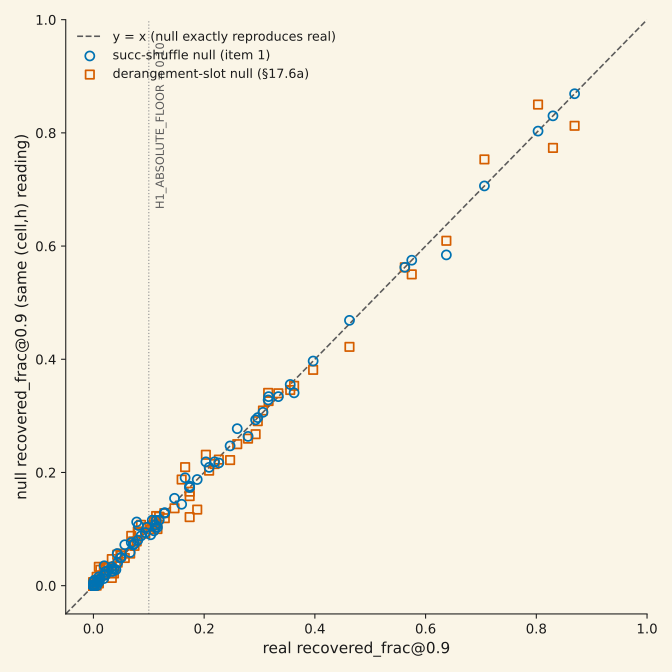
Those scores still needed checking. When we deliberately broke the match between predictions and correct answers, the apparent signal remained. The corrected readout therefore could not establish that the model was following the intended associations.
What we can conclude
Separate tests of the model’s answers did not establish a reliable improvement from the changes to memory writing. An early harmful effect did not establish replication either, and smaller effects remain unresolved.
The proposed link between the measured memory structure and better reasoning was not established. This narrows what we can infer from these particular measurements; it does not show that memory structure can never matter.
The draft is undergoing final checks and editing. The experiment record contains the measurements and corrections, and the measurement paper places this case alongside other evaluation failures.
Results summary updated . Back to work in progress.