 pebble
Measurement failures and controls
When a model appears to fail, how do we check whether the test is wrong?
In progress. Draft in hand; evidence review and editing.
An evaluation can be wrong about a model. It might inspect the wrong layer, assume the model stores information in a particular form, or apply a numerical check that fails even on a correct answer.
This paper collects six cases from our memory experiments where checking the measurement changed how we understood an apparent failure. Each case describes the assumption that broke and the test that exposed it.
Reading the same memory two ways
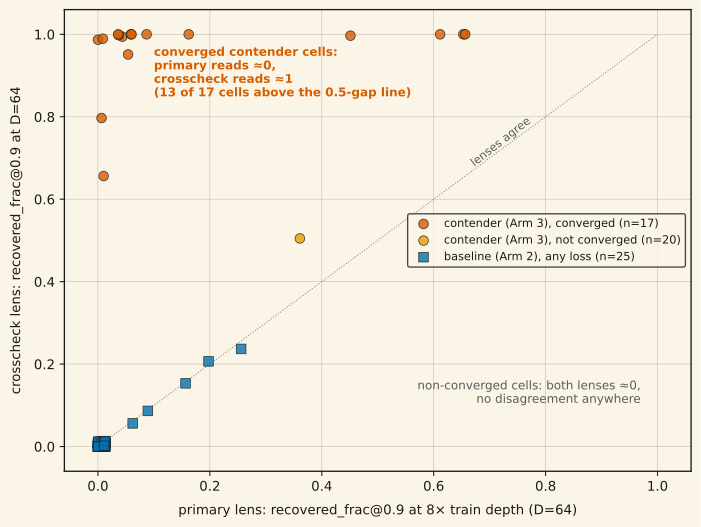
In one experiment, two ways of reading the same trained models gave sharply different answers. The original method assumed information would be arranged in a form checked on another architecture. That assumption did not carry over.
The alternative readout recovered associations the first one missed. We also shuffled the correct answers: its score then collapsed, supporting the conclusion that it was recovering the intended associations.
Looking in the wrong place
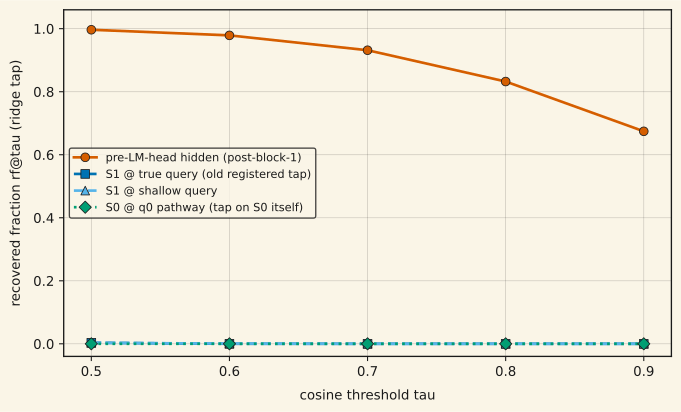
Another test found little evidence of memory in the state it inspected. But erasing a different memory block made task accuracy collapse. The model depended on information the original test was missing. Some of that information became readable only after later processing.
The lesson
Before using a failed test as evidence that a model lacks an ability, check that the test can recognize the ability when it is present. Known correct inputs, deliberately wrong answers, and direct changes to memory help make that check.
Fixing an evaluation does not guarantee a successful model. Some model failures and the study’s original final decision remained after the measurement fixes. These six cases offer practical checks, rather than an estimate of how often evaluations fail across the field.
The draft is undergoing evidence review and editing. Earlier records cover the readout disagreement, memory localization, and corrected reasoning readout.
Results summary updated . Back to work in progress.