 pebble
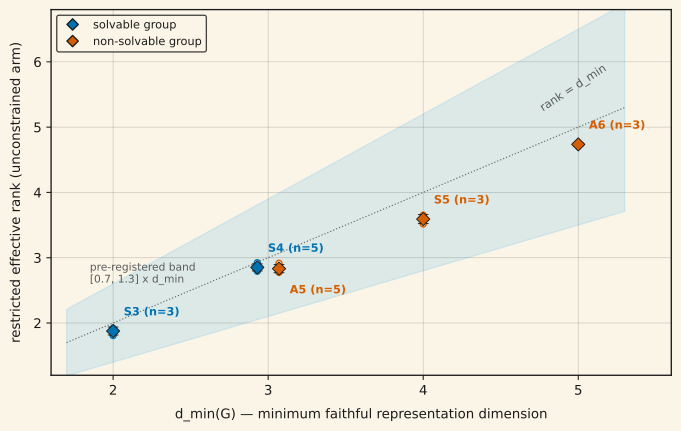
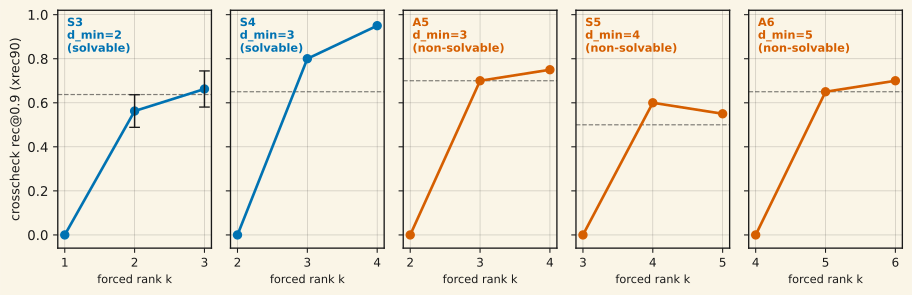
Every finite group G has a minimum dimension d_min(G) below which no faithful orthogonal representation exists — a theorem-grade lower bound on how much state a model needs to represent the group's elements. We trained a fast-weight model on group-word recovery for five groups spanning d_min ∈ {2, 3, 3, 4, 5} and asked whether SGD recruits exactly that much rank. Three results. Correlation: the unconstrained model's restricted effective rank tracks d_min (Spearman ρ = 0.9747, the maximum achievable given a designed tie; all 19 cells inside the pre-registered [0.7, 1.3]·d_min band). Dissociation: the marquee pair S4 vs A5 — same d_min = 3, opposite solvability — lands together on dimension (Welch TOST declares equivalence at margin ±0.5; difference +0.019). Causation: force-capping the model's rank at k = d_min − 1 drives basis-invariant recovery to exactly 0.000 in all five groups, while k = d_min recovers anchor-level performance — a step, not a ramp. The causal cells are single-seed for four groups (S3, the marginal one, was seed-extended to n = 4 and confirmed). The September preprint updates this account: the below-dimension threshold failure follows from the task’s constructed ceiling, while recovery at the chosen reference dimension is empirical.
01Why finite groups
Claims of the form "the model uses rank k" are easy to get wrong. A rank-1 matrix can smuggle d items past an argmax readout; a full-attention model can satisfy "hold K items" with K positions at rank 1 each. To make within-representation rank load-bearing, the task's rank requirement has to be a theorem, not an assumption.
Finite groups give exactly that. Representation theory fixes, for each group G, the minimum dimension d_min(G) of a faithful real orthogonal representation: no matrix family of smaller dimension can represent all of G's elements distinctly while composing correctly. We use five groups:
| group | |G| | d_min | solvable | realization |
|---|---|---|---|---|
| S3 | 6 | 2 | yes | triangle symmetries |
| S4 | 24 | 3 | yes | cube rotations |
| A5 | 60 | 3 | no | icosahedral rotations |
| S5 | 120 | 4 | no | zero-sum hyperplane in ℝ⁵ |
| A6 | 360 | 5 | no | zero-sum hyperplane in ℝ⁶ |
The model learns per-word operators for group elements; recovery is scored on held-out evaluation words against the true representation matrices. The decisional metric throughout is basis-invariant: an orthogonal Procrustes rotation is fitted on a disjoint fit set before scoring, and we report the fraction of evaluation words whose corrected readout exceeds cosine 0.9 against the true matrix (written xrec90 below). The naive scale-only variant of this metric was proven brittle by an oracle-injection test — a mathematically perfect model can score as low as 0.01 on it — and is never used for decisions.
02Correlation: recruited rank tracks d_min
 Open figure at full size
Seed-level means: S3 1.877 ± 0.060 (n=3), S4 2.852 ± 0.054 (n=5), A5 2.832 ± 0.062 (n=5), S5 3.591 ± 0.069 (n=3), A6 4.736 ± 0.023 (n=3). The model has d_min + 2 dimensions available in every case and consistently declines to use the slack.
This leg is pre-registered as corroborating-only: restricting the readout to d_min dimensions partially favors rank ≈ d_min by construction for near-orthogonal blocks. The causal weight sits in §04.
03Dissociation: dimension, not solvability
S4 (solvable) and A5 (non-solvable) share d_min = 3. If recruited rank were tracking computational difficulty — solvable groups admit decompositions that non-solvable groups provably do not — the pair should split. It does not: the Welch TOST on restricted effective rank (n=5 per side, pre-registered margin ±0.5 rank-units) declares equivalence with a difference of +0.0194 (se 0.0368; both one-sided tests ~7× past the critical value).
04Causation: the razor
Correlation admits deflationary readings. The causal test force-caps the model's per-word operator rank at exactly k = d_min − 1, d_min, and d_min + 1 during training, per group, holding everything else fixed. If d_min is genuinely the binding constraint, recovery should be impossible one dimension below it and unimpaired at it — a step function.
 Open figure at full size
At k = d_min: S4 reads 0.800 (anchor 0.650), A5 0.700 (0.700), S5 0.600 (0.500), A6 0.650 (0.650). S3's k = d_min cell at seed 0 (0.450) fell inside the pre-registered ±0.05 marginality window against its bar (0.9 × anchor = 0.495), which triggered the pre-registered seed extension: seeds 1–3 read 0.550, 0.600, 0.650, for a 4-seed mean of 0.5625 — above the bar. The necessity leg is noiseless: 0.000 at k = d_min − 1 in every seed of every group. Verdict: causal confirmation in 5/5 groups; the headline never depended on the S3 extension (it moved S3 from "marginal, routed" to "confirmed").
05What went wrong first (and why the archive matters)
The original 58-cell sweep could not have detected this result: an instrument bug (the "ambient-identity capacity tax") padded the training target with an identity block, so every rank-capped arm paid two dimensions of its budget before touching the group representation, and 37 of 39 force-rank cells tracked the resulting √(k/d_state) ceiling to within 0.07. That sweep's causal verdict was recorded as inconclusive-diagnosed, the padding was fixed (zeros instead of identity, making the target rank exactly d_min), and every causal number above comes exclusively from the post-fix archives. The correlation leg (§02) is unaffected — the unconstrained arm was never rank-capped.
06Limitations
- Single-seed causal cells. S4, A5, S5, A6 razor cells are n=1 (the campaign's flanking-cell convention); only S3 is n=4. The zero at k = d_min − 1 is categorical and replicated wherever seeds exist, but the recovery-side values carry single-seed uncertainty for four groups.
- S3 is noisier than its mean. Per-seed, S3's k = d_min cell clears its own seed's 0.9×anchor bar in only 2 of 4 seeds — driven by anchor noise (S3's anchor swings 0.550–0.800 across seeds). The pre-registered decision uses the fixed launch-time bar (0.495); recomputing the bar from the 4-seed mean anchor would put the mean marginally below it (−0.011). Both readings are disclosed in the design record.
- Convergence health. All ten k = d_min − 1 cells fail the convergence health gate — expected (a rank-starved model cannot converge to the target), but it means the zeros are "cannot represent," not "converged elsewhere." Two groups' anchor-side cells sit just under the health bar (soft convergence at the 8K-step groups), disclosed as non-blocking because the razor reading is anchor-relative.
- Scope. This is single-episode associative recovery of group structure, not multi-hop reasoning over held-out relational structure. The reasoning-transfer stage this gates is designed but not run.
07Reproducibility
Raw per-cell JSONs, harvest analysis scripts, and MD5 manifests are archived in the project repository under experiment-runs/2026-07-09_capability_sweep_harvest/ (correlation + equivalence legs), experiment-runs/2026-07-09_m3fix_harvest/ (post-fix causal cells), and experiment-runs/2026-07-09_m3fix_s3ext/ (S3 seed extension). The figure-generation scripts for this page are at assets/plots/generate_rank_law.py. Total realized compute for the numbers on this page: ≈4.3 H100-hours.