 pebble
Memory capacity
How much can a fixed memory hold before it starts forgetting?
In progress. Draft and results in hand; final review and editing.
A memory that stays the same size could make long conversations less expensive to process. But it also has a limit: it cannot keep adding information forever. To choose a useful memory size, we need to know how much a trained model can actually store in it.
This study measures that limit in a small model whose memory is a matrix. We increase the number of associations it must remember, hold the training budget fixed, and repeat the experiment with different matrix sizes.
What we have found
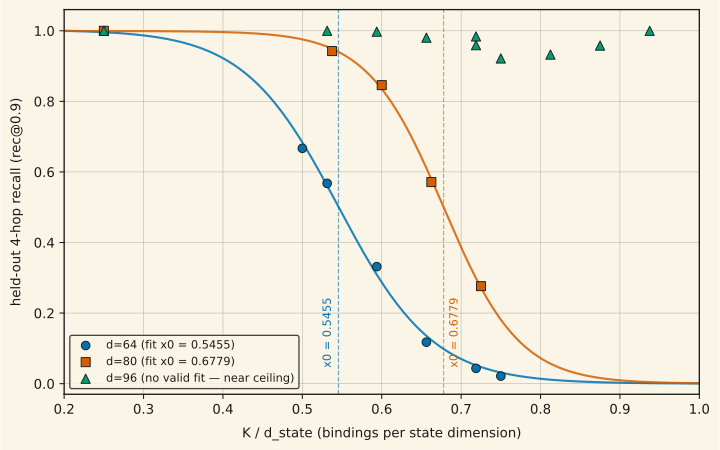
Recall dropped sharply once the memory became overloaded. For a 64-by-64 matrix, the fitted midpoint of that drop was around 35 associations. For an 80-by-80 matrix, it was around 54.
That increase roughly matches the increase in the number of entries in the matrix. The larger memory held more associations, but the amount stored per byte was much the same at those two sizes.
What remains open
We did not locate a comparable drop at the larger tested sizes. Two measured transitions are not enough to establish a general scaling law. These are also learned limits under a particular training budget, rather than mathematical limits on storage.
The tests use synthetic associations and familiar entities. Generalizing to unfamiliar entities remained unsuccessful. The draft uses these results to ask how to size a learned memory, while keeping that question separate from whether it can reason with new information.
The manuscript is undergoing final checks and editing. The original experiment note contains the detailed measurements.
Results summary updated . Back to work in progress.