 pebble
Learned memory and multi-step composition
A model may know how to use a memory but struggle to build it.
In progress. Results collected; bringing the main manuscript together.
Useful memory should let a model do more than retrieve an isolated fact. It should support a sequence of steps: follow one association, use the result to find the next, and keep going.
This is the larger paper taking shape behind the memory studies. We separate two questions: can the model use a correctly built memory, and can training teach it to write that memory itself?
Separating writing from using
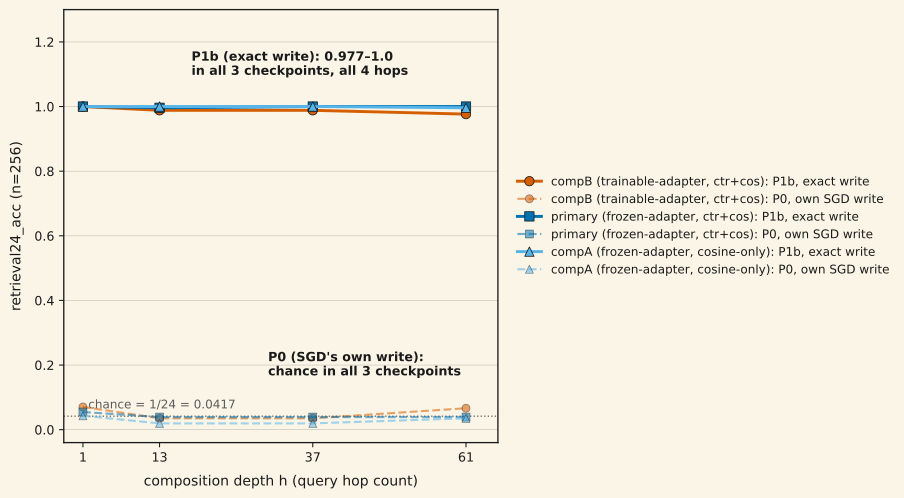
We test the same trained model twice. First it uses the memory it built from the input. Then we supply a mathematically correct memory while keeping the way it reads that memory unchanged. The comparison helps locate where a failure occurs.
In the tested models, supplying the correct memory raised retrieval to near-perfect levels, including after many repeated steps. Their own learned memories often performed near chance. A later comparison with matching sets of entities preserved this difference.
What this suggests
The results point to learning to write the memory as an obstacle in these experiments. Having a way to use a correct memory does not mean training will learn to construct it.
Increasing the main model to 1.31 billion parameters did not resolve the multi-step failures. The separate network that writes the memory stayed the same size, so this does not tell us what scaling that writer would do.
I’m bringing the supplied-memory tests, experiments with more associations, and larger-model results into one manuscript. The aim is to explain where learning fails and which part of the model needs improvement.
Related work in this program: memory as an operation, early read-path experiments, and the operator-bank experiments.
Results summary updated . Back to work in progress.